How to Efficiently Plan a Month-Long European Itinerary in Just One Week
Travel planning is one of my favorite types of planning and I usually like to take my time spending weekends researching at a leisurely pace. But when I spontaneously decided to visit Europe (the week before…) I needed to be a bit more efficient. So, here’s how to efficiently plan a European itinerary if you’re time poor.
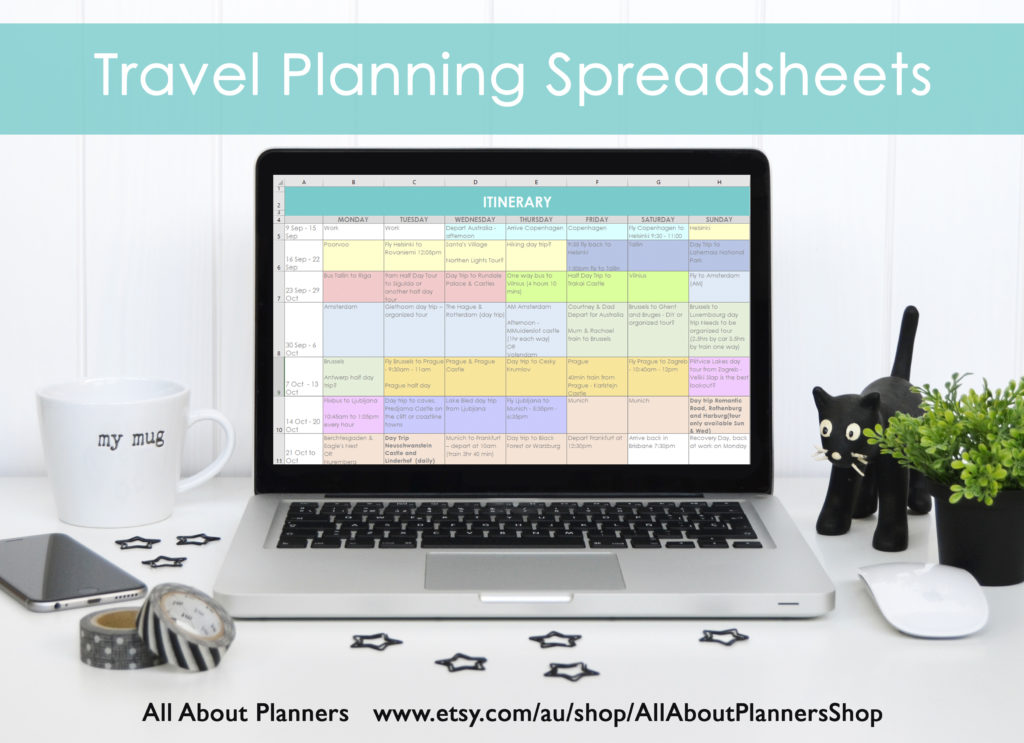
If you’re curious, here is a copy of the itinerary I created in 4 days. Editable version you can customise is available in my shop.

This itinerary includes visiting lesser known parts of the Czech Republic, the main cities in Poland (with some day trips), plenty of northern Italy (including the Dolomites) plus a Singapore stopover. I specifically chose these destinations as I visited during peak season (July – August) and these places were affordable (I did this trip solo) and not crowded.
How to efficiently plan a European itinerary if you’re time poor
Visit less countries
This one is hard. There are 44 European countries and all of them have something unique and special to see! But I’ve found for a month long trip it’s better to limit it to no more than around 7 countries. 30 days less 2 long haul travel days and the arrival day = 27 useable days. Divide this by 7 countries and that’s an average of 3 – 4 days per country.
Factoring in time lost in transit between countries and it probably only leaves roughly 3 days per country. This is the minimum I would recommend. 3 days is fine for smaller countries like Belgium, Luxembourg, Slovenia etc., or if you only want to visit one city and see the highlights. But it definitely won’t be enough for big countries like Spain, France, Germany etc. As you’ll see in my latest itinerary, I spent 10 days in just Poland!
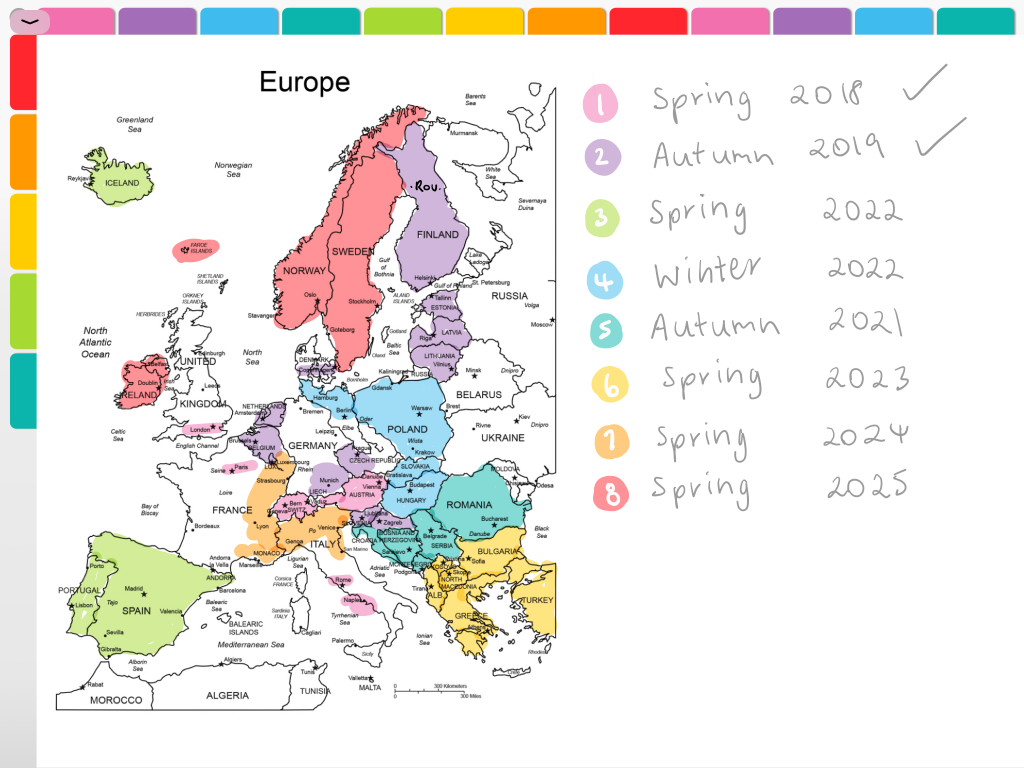
My original plan for seeing Europe… prior to covid. Lucky a digital notebook makes it easy to erase and modify plans.
Read more: How to use a digital notebook (5 functional uses)
I never ever thought I would visit Europe during it’s peak season (July and August) but I decided I’d rather go and it be hot and busy, than sit around at home waiting for a phone call about a potential job offer. I just felt I’d always regret it if I didn’t just go. Especially when travel was off limits for so long during covid.
I’ve been to 2/3 of the European countries now and as I was going so last minute, I tried to pick places that were a bit less mainstream. Poland immediately came to mind as I expected nothing would escalate with the war at the moment, so now would be a good time to go.
Other members of my family had already visited the dolomites last year and it was high on my must see list. So that’s how Italy was added. I also wanted a Singapore stopover to break up the long haul flights. So these 3 countries gave me a rough structure.

I made this itinerary using my Word doc itinerary template – I shared more about it in this post
Avoid peak season
If you go in peak season, you’re probably going to have to pre-book attractions in popular places such as London, Paris, Munich, Barcelona etc. except if you travel to less popular destinations. That is why I went a bit off the beaten path. I knew viewpoints in Poland wouldn’t sell out, so I could skip pre-booking them and have flexibility in my itinerary to visit them during good weather and when lighting is best for photos. This saved me time upfront and I don’t recall ever having to wait longer than 5 minutes in a queue to purchase a ticket to an attraction.
There were a few things I pre-booked such as day trips on an organized group bus tour, Willanow Palace, Warsaw Palace and the free T Fondaco Dei Tedeschi viewpoint in Venice. I think I could’ve gotten away with not pre-booking anything other than the day trip bus tours and the Venice viewpoint.
Prague in July

Versus Willanow Palace in July (the ‘Versailles’ of Poland)

Travel by road or bus
It’s much faster to book bus or train tickets than researching flight routes. There are also usually more options if you go via road or rail with multiple departures per day. Travel via bus and train can also be super cheap in Europe! Flixbus’ are super affordable in Poland and train travel is super cheap (and scenic) in Italy.
I only took one internal flight from Warsaw to Venice. As this was only on a few days per week. I locked this into my itinerary first, and then worked ‘outwards’ planning the rest of the itinerary around it.
Always book a morning bus or train
I usually book trains or buses between 7:30am and 9am depending on how late I plan on staying out the night before. This makes it fast to search options. I don’t have to worry about coming back to the hotel to collect luggage, I can just go straight from the hotel onto my next destination. If there are delays it allows a buffer to get a train later in the day, and it doesn’t feel like a waste of a day when I get to my destination at the other end.
For example, in this itinerary I took a morning train from Venice to Verona, then explored Verona in the afternoon and evening. 3/4 of a day was enough for me to see everything I wanted to see in Verona, and then it was on a train to the next destination the next morning.
For booking trains in Europe, I always use Omio or Trainline. This also makes it faster as I’m only comparing route and costs between 2 search engines.
I also always book high speed / express trains whenever possible so I have more time for exploring!

Italy’s Frecce Trenitalia high speed train network can take you to so many places in a short amount of time (this photo was taken at Bolzano train station)
Take organized group day trips
I prefer to travel on my own, rather than in an organized bus / group tour if I can avoid it. But sometimes places I want to go are logistically difficult to get to, take longer to get there if you don’t have a car and can be more expensive.
I use Viator and Get Your Guide – both of these websites have the most popular day trips from cities all across Europe so are helpful when deciding what day trips to take, how much you might want to fit in if you do the day tour on your own, or if it’s going to be more cost effective and efficient to join one of the group tours on their websites.
If you join a group tour you don’t need to spend as much time researching how to get between places, it pretty much ensures you’ll see the top highlights without the stress of figuring out transport on your own.

I would’ve have been able to visit Adrspach Teplice Rocks without an organized day tour
Try and travel in a loop and take direct flights
I hate wasting time backtracking and always try to travel in a one way direction. I wanted to visit Poland, but Warsaw was the only airport that would fly out of Poland to Italy. So I expanded my horizons a bit. Wroclaw is near the border of both Germany and Prague. So I could fly into either Berlin or Prague. I try and stick to Emirates so I get more points and perks by staying loyal to one airline and since Emirates doesn’t fly into Berlin, I ended up flying into Prague. I wanted to visit Bohemian Switzerland anyway and there are day trips from both Dresden and Prague.
So my route was Prague – Dresden – Wroclaw – Krakow – Warsaw – Gdansk – Venice
But I can’t fly directly from Gdansk to Venice. Gdansk is a bit too far from Sweden and Norway, and too far to Berlin (I try and do no more than 4 hours on a train – I was travelling solo and my bladder can’t hold much longer, I’m not leaving my luggage unattended while I go to the bathroom nor attempting to take it in there with me. Yes, my bladder does factor into my trip planning…).
There was only one flight option from Warsaw to Venice departing at 9:20am. Too early to get a train from Gdansk back to Warsaw in the morning and I always make sure I’m at the destination I need to fly out of the day before just in case there are any train or bus delays / issues. So I ended up splitting Warsaw. This is the first time I’ve ever ‘doubled back’ to a city on any itinerary I’ve ever done. It was a bit annoying as I effectively lost half a day in transit, but I would’ve lost that in the air or waiting around at an airport for a connection anyway. It gave me a 2nd chance to visit viewpoints in better weather as it rained on one of the earlier days I visited Warsaw. It also meant I timed visiting one of the museums on the day it’s free entry 🙂
I still believe it’s more efficient and better to not double back if you can avoid it, but would do it again if it’s a place I really want to go (and I did really enjoy Gdansk!)
Use ChatGPT to speed up your research
ChatGPT was a huge help in efficiently researching things to see and do. Some of the keywords / searches I used to speed up my research, which you may want to incorporate into your own trip planning:
- Generate a 3 day itinerary for Warsaw. I’m visiting in July. Include viewpoints and must see holocaust museums. Put the information into a daily schedule (table format) from 8am – 8pm. Make it a packed itinerary
- Tell me the driving, train and flight times between Gdansk and Krakow
- I used prompts like this to decide what method of transport to take between cities
- Generate a 14 day Poland itinerary. Visit Wroclaw, Krakow, Warsaw and Gdansk. Include at least 1 day trip from each city. Itinerary must include a day trip to Auschwitz.
- I like a ‘go go go’ / packed itinerary and find chatGPT’s itineraries are more slower paced. So I could usually take one of their longer itineraries
(say 14 days) and fit it into a shorter timeframe (I spent 10 days in Poland)
- I like a ‘go go go’ / packed itinerary and find chatGPT’s itineraries are more slower paced. So I could usually take one of their longer itineraries
Note: I wouldn’t rely on chatGPT for up to date information on attraction opening hours, costs and logistics of getting from A to B. Check this directly on Google or by visiting the attractions’ website. It also only added 1 viewpoint and via researching on blogs there were three good viewpoints that are worth visiting.
Read more: Using ChatGPT to create a travel itinerary – time saver or waste of time?

Use travel blogs for sample itineraries
ChatGPT is helpful, but it’s basically a robot. I like to read about the experiences and opinions of real people. Real people also share their real itineraries and usually give tips about what they would change or do differently. That’s the info I find most helpful when researching. I also like seeing photos of places to help me decide if I want to go there.
Some blogs I found especially helpful for planning this trip (I regularly refer to these websites for other Europe trip planning too)
Dolomites:
- Earth Trekkers
- Full Suitcase
- Our Escape Clause
- Moon & Honey Travel (this website was a new find for me, has lots of helpful info about hiking routes for the dolomites)
Poland
- FindingAlexx
- Earth Trekkers
Singapore
- Too many website to name! I would focus on which attractions are on your must do list and go from there. Singapore isn’t very big and has a great public transport system so it doesn’t take too long to go between attractions.
Stay in hotels near the main train and / or bus station
I used to want to stay right in the centre of the action in the old towns but these days I prefer to stay in hotels that are a bit farther out near the main train station. It’s easier to just walk to the hotel than have to rely on a taxi or uber. The hotels in outer areas are usually more modern (and are typically hotel chains that can give you discounts for repeat visits), plus they can be a little bit cheaper.
As this itinerary was during summer and Europe doesn’t get dark until 8 – 10pm in summer (depending on what countries you’re going to), I felt comfortable being a little farther out of town as it should be just getting dark once I’d finished dinner and was walking back to the hotel.

Flixbuses are an easy and inexpensive way to travel across Europe. The Flixbus bus stations are usually on the outskirts of the old towns (most were near the main train stations in the Polish cities too – very convenient)
Specific hotel search criteria
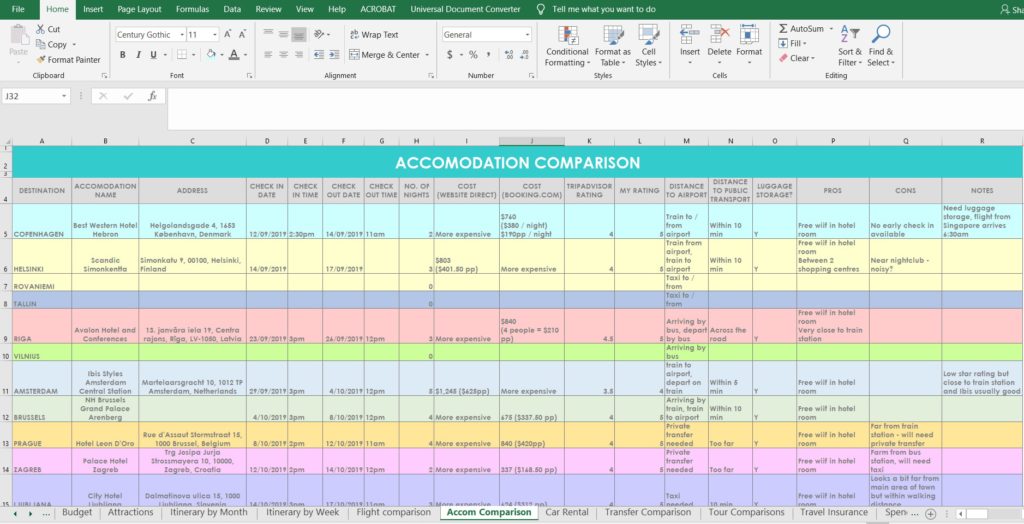
Knowing what area I wanted to stay in made it really fast and easy to compare and pick hotels. I always use booking.com to book my hotels. If you book enough hotels with them, they give you a ‘genius’ discount which is usually another 10% off but sometimes other promotions too, like a free room upgrade. By only using one search engine it also sped up my research process.
I prefer to use booking.com rather than booking direct through the hotel, as it keeps all my bookings in one place, it’s easy to use the chat function to quickly message the hotel, and the price usually works out cheaper than booking directly through the hotel as booking.com always seem to have some promotions.
Booking.com’s map view is fantastic for zooming straight it on the area near train and bus stations. I also use these search filters:
- Air-conditioning (a must have during a European summer!)
- Star rating of 8.0+
- Free wifi
- Luggage storage
- Price per night
This narrows the options down fast. I then narrow it down even further to 2 or 3 hotels and do a quick check against their rating on Tripadvisor. I try to book hotels that are rated 4 stars or more on Tripadvisor. Since I was going to smaller destinations there were usually only 2 hotels left to pick from so this made it fast and easy to book my accommodation. Plus, chain hotels like Ibis, Mecure and NH Hotels are usually near train stations and they’re usually a safe bet that they’ll be fine for a short stay. The larger hotel chains are also more likely to have rooms left if you book your trip last minute.
The prices were inflated as I was booking so last minute, I estimate I could’ve saved 30% of the hotel cost by booking the trip my usual 6 – 9 months in advance. If you run the same search you’ll notice the price jumps a few dollars per day, the closer it gets to the dates you wish to stay there.
More info on how I research and book hotels in this post: How to choose a hotel (my step by step process)
Batch booking
I like to batch pretty much everything I do in my life. By clustering similar tasks together I’m far more efficient at getting things done.
Since I only had 1 week to plan the trip, I scheduled what I needed to book on each day. I set aside one day for the accommodation (I had 14 hotels to choose and book), one day for train, bus and flight tickets and one day for attractions (I didn’t end up pre-booking all of these but researched to know what the cost would be, opening hours etc.)
Related post: 20 Productivity & Time Management ‘Rules’ I Live By
Schedule days into morning, afternoon and evening
I used to schedule my itineraries down to the hour and sometimes on especially busy travel days, I still do this. but generally I take a morning, afternoon and evening approach to scheduling. If the weather is supposed to be afternoon storms and I had planned on visiting viewpoints in the afternoon, I can flip the itinerary to do the afternoon activities in the morning instead.

Use your time in transit to research
I’m a tad obsessed with getting the ‘postcard’ photos. I used bus and train rides to research photo spots, then screenshotted and favorited them on my phone. I would normally do this before leaving for a trip, include them in the printed itinerary, then take out the piece of paper to compare in person once I get to my destination, but doing it this way on my phone worked fine too.
Other things I researched in transit were food places, the location of department / chain stores I wanted to visit and opening hours of attractions.
I hope you found this post helpful! If there are any other travel tips you’d like to see or an itinerary for a particular destination, leave me a comment below.
Here’s that link to download a copy of the itinerary. Editable version you can customise is available in my shop.
More itinerary planning tips
- How to use Canva to make a travel itinerary (is it better than Word and Excel?)
- Using ChatGPT to create a travel itinerary – time saver or waste of time?
- 115 Things to Google before your next vacation
Some of my past Europe itineraries
- 4 Week Paris and London Itinerary (plus thoughts from my first time trying slow travel)
- Best of Paris (1 day Itinerary with suggested timing for each attraction)
- Copenhagen Weekend (2 Day) Itinerary (What to see & do and best photo spots)
- 5 Day Amsterdam Itinerary (including 2 day trips)
Liked this post? Pin it!